Louis Vuitton Authentication Guide & Date Codes
How to Authenticate a Louis Vuitton Handbag
From the historic date-code system to the modern embedded microchip — a complete guide to reading manufacturing marks, factory codes, and the craftsmanship details that reveal a genuine Louis Vuitton.
The Microchip Era
Louis Vuitton has fundamentally changed how its products are identified — moving away from the printed date code entirely.
RFID Microchips Replace Date Codes
From 1 March 2021, Louis Vuitton began embedding a small RFID (Radio-Frequency Identification) microchip inside its products and phasing out the printed date code. Some pieces produced in 2021 may still carry a date code, and the changeover rolled out gradually over the following couple of years. The microchip is hidden within the lining or a seam and is invisible from the outside.
Important · The chip can only be read by Louis Vuitton's own equipment — buyers cannot self-verify a bag using the chip alone, so craftsmanship checks remain essential
What This Means for Authentication
Because the chip is not consumer-readable, authenticating a modern Louis Vuitton relies on the same fundamentals as always: the precision of the heat stamp, the quality and alignment of the canvas, the weight and finish of the hardware, and the regularity of the stitching. For bags made before 2021, the date code below remains the key reference.
Understanding Date Codes
Contrary to popular belief, Louis Vuitton handbags do not carry serial numbers. Instead they were given a date code identifying where and when the item was made.
What a Date Code Is · Location & Manufacturing Marks
Louis Vuitton handbags (excluding luggage and rare limited-edition pieces) do not have serial numbers. Rather, they have a "date code" stamped on an interior tab or directly into the lining. A date code identifies the manufacturing location and date — it is not in itself proof of authenticity, but its format must be correct for the era. With the exception of early pieces (early 1980s and older), a date code can be found on virtually every Louis Vuitton item, including sunglasses.
Most date codes combine letters and numbers: the letters indicate the country of manufacture, while the numbers indicate the production date.
Date Code Formats by Era
The structure of the date code changed several times. Match the format to the period the bag is claimed to be from.
| Manufacturing Period | Format |
|---|---|
| Pre-1980s | No date codes. |
| Early 1980s | Three or four numbers — the first two are the year, the last one or two are the month. E.g. "836" = June 1983. |
| Early–late 1980s | Three or four numbers followed by two letters: numbers as above, last two letters = country. E.g. "874VX" = April 1987, made in France. By 1990 the factory letters had moved before the numbers. |
| 1990–2006 | Two letters then four numbers. Letters = factory; 1st & 3rd numbers = month; 2nd & 4th = year. E.g. "VI1025" = France, December 2005. |
| 2007 – Feb 2021 | Two letters then four numbers. Letters = factory; 1st & 3rd numbers = week of the year; 2nd & 4th = year. E.g. "SD2057" = USA, 25th week of 2007. |
| Mar 2021 onward | Microchip Most new pieces have no printed date code — replaced by an embedded RFID microchip during a gradual changeover. |
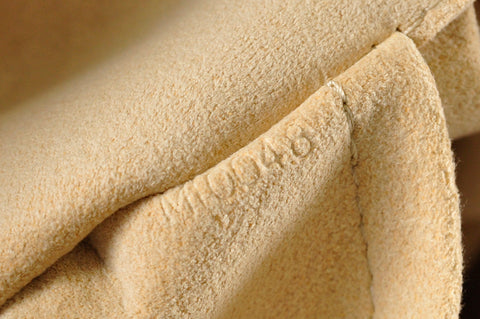

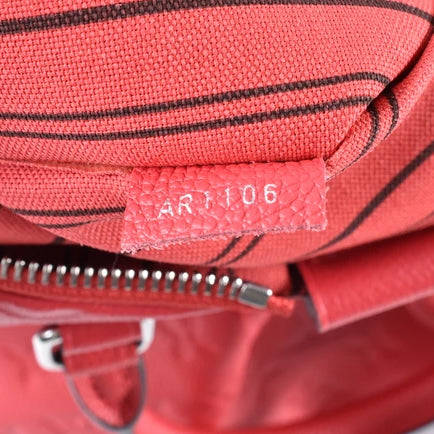
Authentic Bags With No Date Code?
Authentic Louis Vuitton handbags with Alcantara (suede) linings may have date codes that are very faint or have worn away altogether. This is common on older bags, or where a lining has been cleaned or replaced. A missing or faded code does not on its own mean a bag is fake.
Factory Location Codes
The two letters in a date code identify the country of manufacture. The list below is a reference of common codes — it is not exhaustive, and some letter pairs are shared across countries.
| Country | Factory Letter Codes |
|---|---|
| France | A0, A1, A2, AA, AAS (special order), AH, AN, AR, AS, BA, BJ, BU, DR, DU, DT, CO, CT, CX, ET, FL, LW, MB, MI, NO, RA, RI, SA, SD, SF, SL, SN, SP, SR, TA, TJ, TH, TN, TR, TS, VI, VX |
| Germany | LP, OL |
| Italy | BC, BO, CE, FN, FO, MA, NZ, OB, PL, RC, RE, SA, TD |
| Spain | BC, CA, LO, LB, LM, LW, GI, UB |
| Switzerland | DI, FA |
| USA | FC, FH, LA, OS, SD, FL, TX |
The Heat Stamp
Beyond the date code, the brand heat stamp is one of the most reliable tells. Look closely at the lettering.
Lettering · Crisp, Even & Rounded
The "LOUIS VUITTON" stamp should be clean and evenly impressed, with thin, sharp, rounded letterforms. The Os are noticeably round — almost circular — and the Ts in "VUITTON" sit close together with their tops nearly touching. The registered-trademark "®" is small and neat. Counterfeits often use thicker, more crowded, or unevenly heated lettering.
- Round Os — Letters look bubbly and even, never narrow
- Close-set TTs — The two Ts in VUITTON nearly touch at the top
- Made-in line — "made in France / Spain / Italy / U.S.A." (lowercase "made") should match the factory code
- Red flag — Smudged, crooked, or overly bold stamping
Materials & Hardware
Genuine Louis Vuitton craftsmanship shows in the canvas alignment, the stitching, and the weight of the metal.
Canvas & Stitching · Symmetry & Tonal Thread
On most symmetrical styles the monogram or Damier pattern is positioned so the canvas mirrors neatly across the central seam, and logos are not awkwardly cut off. Stitching is even and consistent, traditionally in a slightly mustard-yellow tonal thread on monogram canvas, with the same stitch count repeated on matching panels.
- Canvas — Symmetrical, well-aligned pattern at the seams
- Thread — Even, regular, mustard-toned stitching
Hardware · Weight & Engraving
Authentic hardware is solid and substantial — zipper pulls, lock plates, and feet feel weighty for their size. Gold-tone hardware is warm and even and should not flake, though genuine brass naturally develops a patina with age. Engraved "Louis Vuitton" lettering on zippers and lock plates is crisp and evenly spaced. Lightweight, hollow-feeling, or roughly engraved metal is a warning sign.
- Feel — Heavy, solid brass-quality hardware
- Engraving — Sharp, even "Louis Vuitton" lettering
Knowledge Is Your Best Protection
No single mark proves authenticity on its own — and from 2021 the date code is being replaced by a microchip. Read the full picture: the format of any date code, the precision of the heat stamp, the symmetry of the canvas, and the weight of the hardware. When you buy or consign with Glampot, our authentication team checks every piece.
Frequently Asked Questions
Do Louis Vuitton bags still have date codes?
No. Louis Vuitton phased out date codes from around March 2021 in favour of RFID microchips under the lining, with codes progressively disappearing over the following couple of years. Pre-changeover bags keep their stamped codes; newer bags have none, so a fresh date code on recent production is a reason to look more closely rather than reassurance.
Can you check an LV microchip yourself?
No. The chip can only be read by Louis Vuitton's proprietary equipment and staff applications. Phone apps may detect that a chip is present but cannot read or verify the data — and counterfeiters now embed dummy chips, so detecting "a chip" proves nothing. Authenticating a chipped-era bag relies on physical inspection and professional services such as Entrupy.
Where can I buy or sell an authenticated Louis Vuitton bag in Malaysia?
Visit Glampot at our store in Mid Valley Megamall, Kuala Lumpur (our only store). When you buy or consign with us, every piece is authenticated by hand by a team handling preloved luxury since 2007, with Entrupy, Real Authentication or Bababebi used when needed.
What does a Louis Vuitton date code like SD2058 mean?
Post-2007 codes read: two letters for the factory, first and third digits for the week, second and fourth for the year — so SD2058 decodes as the 25th week of 2008 from an SD (US-associated) workshop. In 1990–2006 codes the digits mean month and year instead, so knowing the era is essential to decoding correctly.
Is "made in U.S.A." on a Louis Vuitton a sign of a fake?
No. Louis Vuitton has produced in the USA since the 1980s, alongside workshops in France, Spain, Italy and Germany. What matters is consistency: on pre-2021 bags the heat stamp's country should match the date code's factory letters. A "made in France" stamp with a US factory code, or vice versa, is the actual warning sign.
Does a correct date code mean the bag is authentic?
No. Date codes are not serial numbers — many bags share the same code, and counterfeiters copy valid ones. A wrong code can disprove a bag, but a correct one proves little. Authenticity is judged on the whole bag — canvas, vachetta, stitching, hardware, heat stamp — ideally confirmed by professional authentication.
Authentication Guide
Reference photos from Glampot's own collection. For educational purposes only. Glampot is not affiliated with Louis Vuitton.
